The 10 Hiking Essentials: What I Actually Carry (and What I'd Upgrade)
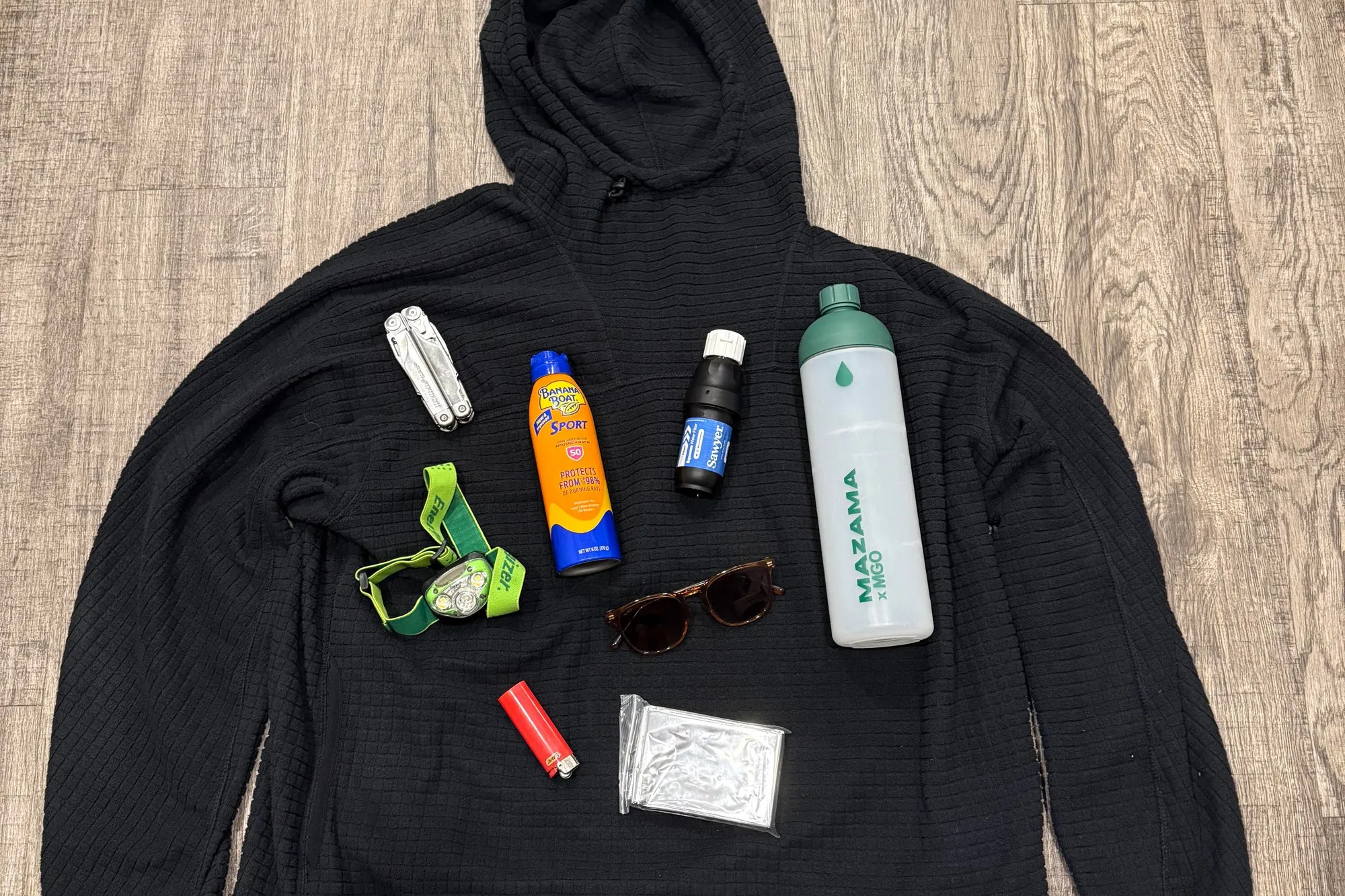
The ten hiking essentials are the checklist that keeps a day hike from turning into a bad night out. The list is always the same ten. Here’s the gear I carry for each, and the upgrade I’d make where mine is due for one.
1. Navigation
I navigate off my phone with onX and The Dyrt, maps downloaded before I head out. My phone has never died on me, but I lose signal all the time, so the downloads do the real work. What I don’t carry yet is a backup that can’t die: a simple baseplate compass like the Suunto A-10. Cheap, light, no batteries.
The bigger add on my list is a Garmin inReach Mini 2 for satellite SOS and texts when there’s no service. It’s not cheap and it needs a subscription, but it’s the next safety piece I’ll buy.
2. Sun protection
$15 sunglasses from Target with a Chums retainer so they don’t sink in a lake, plus sunscreen. I learned that one the hard way: forgot it on a hike once and peeled for weeks. When the sun is really cooking I throw on an REI Sahara Shade sun hoodie, which beats reapplying sunscreen to your arms all day.
3. Insulation
My layer is a Mountain Hardwear Summit Grid Hoody, a grid fleece that breathes while you move and holds heat when you stop. At around 11 oz it’s the piece I’d lighten. A 90 gsm Polartec Alpha Direct hoodie like Senchi Designs does the same job for about 5 oz. The trade is durability: Alpha Direct is thin and snags easily, so it’s not the layer for bushwhacking.
4. Illumination
My headlamp is about 10 years old. It still turns on, but it’s well past due. The Nitecore NU25 is the one I’d grab: under 2 oz, USB-C rechargeable, 400 lumens. If your light is as old as mine, this is an easy swap.
5. First-aid
A homemade kit: bandages, Neosporin, Advil, and tape in a small bag. In years of day hikes I’ve reached for it exactly once, for a band-aid, but that once is why it rides in my pack. If you’d rather not build your own, the Adventure Medical .5 is a solid prebuilt kit for a couple people and a couple days.
6. Fire
A mini BIC lighter: light, cheap, and usually reliable. Usually. Mine has failed on me, which is exactly why I now keep a box of matches in a ziplock too. A lighter that won’t spark is useless, and matches weigh nothing.
7. Repair kit and tools
Duct tape wrapped around a water bottle to save space, plus a knife. For the full toolbox I bring my Leatherman Surge, I’ve used it to saw through branches and cut cord out there, though at 12 oz it’s a lot to haul for a day hike. That’s why I’m eyeing the Leatherman Micra instead, under 2 oz and it still has scissors, a blade, and a driver.
8. Nutrition
Always a PB and J, plus Honey Stinger waffles for a quick hit of energy on the move (cookies and cream is the one). I also pack one more snack than I think I’ll need, since hikes run long more often than they run short.
9. Hydration
I treat water with a Sawyer Squeeze and carry about 2 liters between my Mazama bottle (the Sawyer threads right onto it) and a Nalgene. This is the one category I’ve got dialed. Full breakdown in my Sawyer Squeeze review.
10. Emergency shelter
This is the one I take most seriously, because I’ve watched it matter. I once helped call in a medevac for a hiker who fell off the side of a mountain, and we used a reflective blanket to catch the sun and flag the helicopter down. I’ve carried one ever since.
Mine is a cheap Mylar blanket, the kind you hope you never unfold. A SOL Emergency Blanket is the same idea but tougher and won’t shred the first time you use it. The upgrade I want is a SOL Escape Bivvy, a breathable sack you can actually climb into and sleep in.
That’s the ten
Cover all ten and you’re set for a day hike. All of it rides in my Osprey Talon 26. Get each one handled, then upgrade whatever’s holding you back first.